
50 Years of Molecular Ordering and Innovation (1977–2027)
16–19 September 2027
Department of Chemistry, Indian Institute of Technology Guwahati, Assam, India
Conference begins in
16 – 19 Sept 2027
4 Days
9:00 AM – 5:00 PM
Daily Sessions
IIT Guwahati
Offline / On-Campus
150 – 200
Participants
Over the years, research on liquid crystals (LCs) has produced significant advancements in the understanding of supramolecular self-assembly and related technological applications. The discovery of liquid crystal displays and their commercialisation made the field more vibrant and multiplied the efforts of the scientific community in the quest for new materials with interesting properties. Understanding the structure–property correlations in LCs is a very important area for translating scientific findings into applications, and it requires a truly interdisciplinary effort.
This special state of matter — a combination of order and mobility intermediate to solids and liquids — is extremely sensitive to external stimuli such as temperature, pressure, light, and electrical and magnetic fields. Chemically, LCs may be organic, organometallic or inorganic in nature, and are broadly classified as thermotropic and lyotropic depending on the stimulus that brings about the phase transitions. A thermotropic LC is typically made up of two components: a rigid core and flexible chains connected to that core through different linking groups.
While the general concept of stabilising a liquid crystal was based on rod-like (calamitic) anisotropic molecules, in 1977 S. Chandrasekhar and co-workers showed that disc-like (discotic) molecules can also exhibit liquid crystalline phases — a discovery that motivated researchers to venture into many unexplored frontiers. The discovery of polycatenars, banana-shaped LCs, dendrimeric LCs, polymeric LCs and many other unconventional shapes followed.
Calamitic LCs have already marked their relevance and impact by supporting the billion-dollar display industry, while the corresponding story for discotic liquid crystals (DLCs) is a work in progress with huge potential, particularly in the area of organic electronics. This international conference provides a platform for all researchers working on discotic liquid crystals and their applications, at a very special moment in time — the 50th anniversary of DLCs.
| Mode | Offline (On-Campus) |
| Duration | 4 Days |
| Dates | 16 – 19 September 2027 |
| Daily Timing | 9:00 AM – 5:00 PM |
| Academic Division | Department of Chemistry, IIT Guwahati |
Abstract and registration deadlines will be confirmed closer to the event. Please check this page for updates.
To be announced
Oral and poster abstracts invited across all conference topics.
To be announced
Notification of acceptance will follow shortly after the deadline.
To be announced
Registration is limited to a maximum of 200 participants.
16 – 19 September 2027
IIT Guwahati campus, Assam, India.
Scientific sessions will span the chemistry, physics and applications of disc-shaped and related self-assembling mesogens.
Molecular architectures, cores, linkers and peripheral chains.
Columnar ordering, stacking interactions and hierarchical structures.
Mesophase characterisation by POM, DSC and X-ray scattering.
One-dimensional conduction, OFETs, OLEDs and photovoltaics.
Emissive columnar phases, energy transfer and light harvesting.
Banana-shaped, dendrimeric, polymeric and hybrid mesogens.
Solvent-driven assembly, chromonics and soft biological interfaces.
Response to temperature, pressure, light, electric and magnetic fields.
Mesogen-based sensors and responsive diagnostic platforms.
Organometallic and coordination-driven liquid crystals.
Computational insight into mesophase stability and dynamics.
From laboratory materials to translational technologies.
Indicative themes — the final list of scientific sessions will be published with the detailed programme.
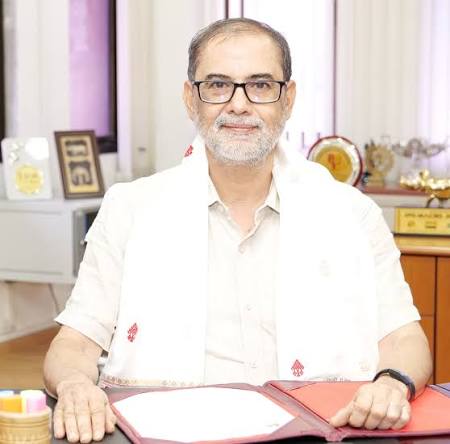
Director, IIT Guwahati
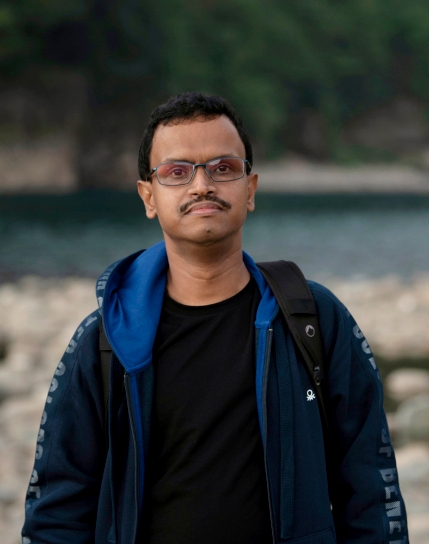
Head, Department of Chemistry, IIT Guwahati
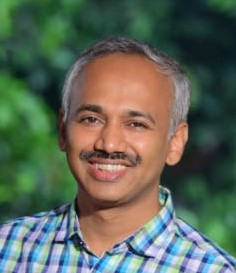
Department of Chemistry, IIT Guwahati, Guwahati, India
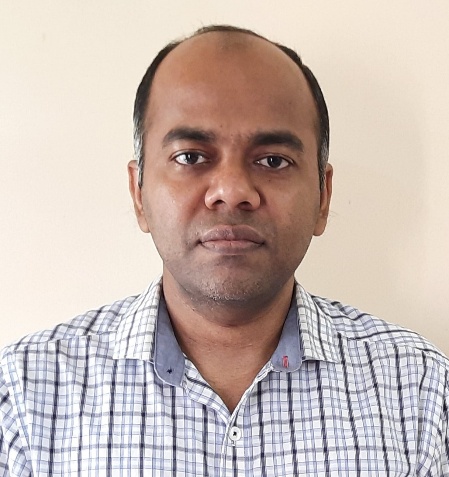
Department of Chemistry, IIT Guwahati, Guwahati, India
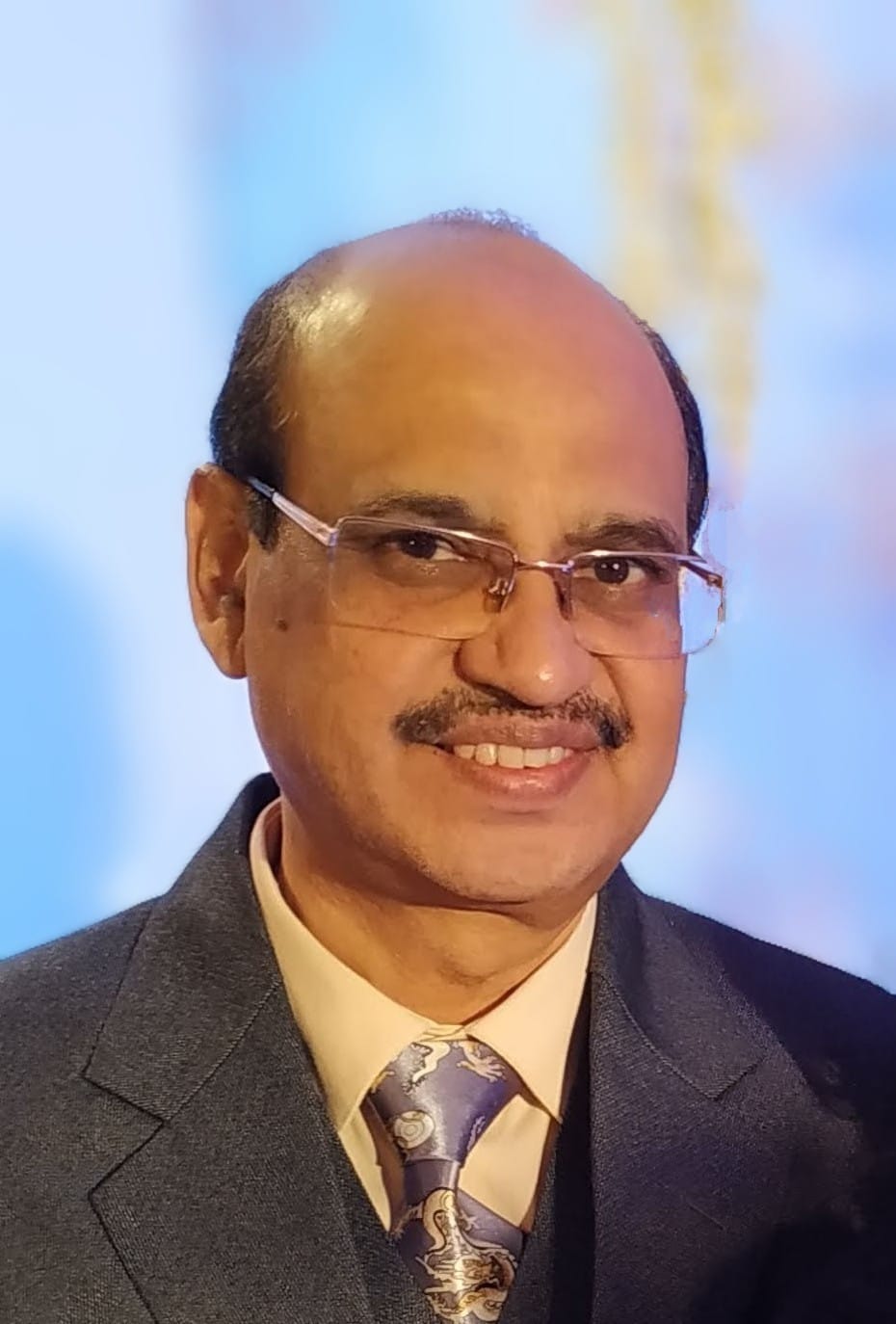
Raman Research Institute & Sharda University, India
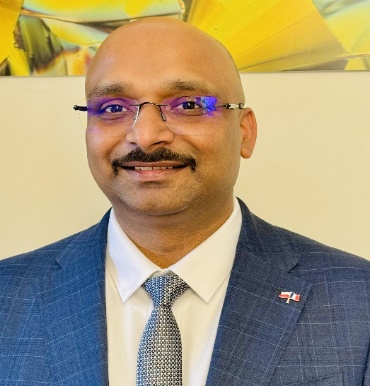
UDSMM, Université du Littoral Côte d'Opale (ULCO), France
IPCMS, University of Strasbourg, France
Prof. Achalkumar completed his BSc at SDM College, Ujire, and his MSc at Mangalore University in 2001, after which he spent two years at the Biocon group of companies, Bengaluru, working on the synthesis of biologically active compounds. In 2003 he joined the group of Dr. C. V. Yelamaggad at the Centre for Nano and Soft Matter Research (formerly the Centre for Liquid Crystal Research), Bengaluru, for his PhD on the synthesis and characterisation of liquid crystals.
After completing his PhD in 2007, he joined Prof. Richard J. Bushby and Prof. Stephen D. Evans at the Centre for Molecular Nano Sciences, University of Leeds, UK, as a postdoctoral fellow, working on the self-assembly of lipid bilayers and photopatternable SAMs. From the end of 2009 he worked in the Bioinspired Materials Team of Prof. Yasuhiro Ishida and Prof. Takuzo Aida at the RIKEN Advanced Science Institute, Wako, Japan, on molecularly imprinted polymers and liquid crystals as chiral reaction media.
He joined the Department of Chemistry, IIT Guwahati, as an Assistant Professor in 2011 and was promoted to Full Professor in 2019. His research spans liquid crystals, organic electronics, supramolecular chemistry and chemical sensors. He has published 130 research papers, 5 book chapters, 1 co-edited book, 8 conference proceedings and 9 patents, with over 3,350 citations and an h-index of 34. He is also associated with the School of Interdisciplinary Studies and Sustainability at IIT Guwahati.
He received the ILCS Silver Medal (2019) and the CRS Silver Medal (2023), and was elected Fellow of the Royal Society of Chemistry (FRSC) and Fellow of the Indian Chemical Society in 2023. In 2023 he became an Associate Editor for Journal of Materials Chemistry C and Materials Advances (RSC), and in 2026 he joined the Editorial Board of Scientific Reports (Springer Nature). He has also served as Guest Editor for Journal of Materials Chemistry B and ChemPhysChem.
Prof. Bhabak received his BSc (2003) from Calcutta University and his MS (2006) from the Indian Institute of Science, Bangalore, where he also obtained his PhD in 2009 under the supervision of Prof. G. Mugesh. In 2010 he joined Humboldt-Universität zu Berlin as an Alexander von Humboldt Fellow to work with Prof. Christoph Arenz, and after a short stay at the University of Oxford, UK, joined Presidency University, Kolkata, as an Assistant Professor in 2013.
He joined the Department of Chemistry, IIT Guwahati, in 2015 as an Assistant Professor and is currently an Associate Professor. His research interests include the rational development of fluorogenic hydrogen sulfide donors and conjugate prodrugs of anticancer and anti-inflammatory drugs. He also develops organoselenium compounds as novel anticancer agents while elucidating their mechanistic basis.
Prof. Sandeep Kumar is an Emeritus Professor at Sharda University, India. He obtained his PhD from Banaras Hindu University, Varanasi, in 1986, and was a Postdoctoral Research Fellow at the Hebrew University of Jerusalem; Technion, Israel Institute of Technology; the Scripps Research Institute, La Jolla, USA; and the University of Mainz, Germany, during 1988–1995. He joined the Centre for Liquid Crystal Research, Bangalore, to start a new chemistry laboratory in 1995, and in 2002 moved to the Raman Research Institute, Bangalore, from where he superannuated in November 2019.
He was a Visiting Research Professor at the Naval Research Laboratory, Washington DC (1999–2000) and at National Dong Hwa University, Hualien, Taiwan (2008), and E.T.S. Walton Visiting Professor at Trinity College, Dublin, Ireland (2012–2013). He has published more than 350 research papers in peer-reviewed international journals, 3 books, 13 book chapters and 10 patents, receiving over 12,000 citations with an h-index of 50 and an i10-index of 236.
He was awarded the inaugural LG Philips Display Mid-Career Award by the International Liquid Crystal Society in 2008, the Indian Liquid Crystal Society Lifetime Achievement Award in 2020 and the Professor Shivaramakrishna Chandrasekhar Lecture Award in 2023. Prof. Kumar has made outstanding contributions to the field of liquid crystals, with the highest number of publications on discotic liquid crystals in the world. He appears in the world's top 2% scientists list published by Stanford–Elsevier (2021–2024), and ScholarGPS places him 29th in the top 0.05% of all scholars worldwide in the liquid crystal field. His research interests include the design, synthesis and applications of liquid crystals, green chemistry and nanotechnology.
Dr. Dharmendra Pratap Singh is an Associate Professor at the Université du Littoral Côte d'Opale (ULCO), France. He is a member of the Unité de Dynamique et Structure des Matériaux Moléculaires (UDSMM) laboratory and head of the first-year cycle of Industrial Engineering at the Engineering School of ULCO. He obtained his PhD from the Department of Physics, University of Lucknow, India, in 2016. His current research focuses on columnar materials, discotics, ferroelectrics, nematic and ferroelectric nematic liquid crystals, along with their nano-dimensional counterparts, for studying charge transport mechanisms and their applications in energy, sensing, thermoelectricity, optoelectronics, photovoltaics and organic electronics.
In 2025 he received the Silver Medal Award from the Indian Liquid Crystal Society for his contribution to the field, having earlier received the Young Scientist Award from the Indian Science Congress (2017), the Best Research Award from the Indian Liquid Crystal Society (2012), the SPIE Early Career Award at Cambridge University (2013), a Best Research Award from the Korean Display Society (2015) and the prestigious Raman–Charpak Fellowship (2014).
He has published around 120 research articles and 4 book chapters, and is principal investigator of projects including PHC Star, Procore, Galilée, Alliance and Samuel de Champlain with South Korea, Hong Kong, Italy, the United Kingdom, Poland, Belgium and Canada respectively. He serves as a reviewer for more than 40 journals from RSC, ACS, APS, Wiley, Elsevier, AIP, IOP, Springer and Nature, is a lifetime member of the International and Indian Liquid Crystal Societies and an affiliate member of the RSC and APS, and is a Guest Editor for journals published by RSC, Elsevier, Wiley and Springer.
Dr. Bertrand Donnio is a French chemist, CNRS Research Director, and Head of the Department of Organic Materials (DMO) at the Institut de Physique et Chimie des Matériaux de Strasbourg (IPCMS), affiliated with the University of Strasbourg. After studying chemistry at the Université de Rennes 1, he earned his PhD from the University of Sheffield in 1996 and later obtained his Habilitation (HDR) from the University of Strasbourg in 2009.
Joining IPCMS as a CNRS researcher in 1999, his career includes high-profile international collaboration, notably serving at the COMPASS joint international laboratory (CNRS–Solvay–UPenn) at the University of Pennsylvania from 2013 to 2015. His research lies at the intersection of soft matter physics, nanotechnology and organic chemistry, focusing primarily on liquid-crystalline architectures, dendrimers, supramolecular self-assembly and functional hybrid organic–inorganic materials — topics on which he has published extensively in leading scientific journals.
DLC-50 will bring together leading researchers in discotic liquid crystals from across the world. The list of plenary, keynote and invited speakers is being finalised and will be published here.
Invitations to plenary and keynote speakers are currently in progress. Confirmed speakers, together with their talk titles and affiliations, will appear in this section as they are announced.
Plenary Lectures
Pioneers of the discotic field.
Keynote Lectures
Leaders shaping current research.
Invited Talks
Emerging voices and new directions.
Speaker announcements will be shared with all registered participants by e-mail.
No specialised software or tools are required for participation.
Minimum: 150 Participants
Maximum: 200 Participants
Seats are limited; registrations are confirmed on a first-come, first-served basis.
Participants wishing to present their work are invited to submit an abstract for oral or poster presentation, prepared using the official conference template.
Download the official DLC50 abstract template and prepare your abstract in the prescribed format before submitting it through the portal.
Download Template (DOCX) View in browserOnce your abstract is ready, submit it through the online conference portal. You will receive an acknowledgement by e-mail, and the scientific committee will communicate the outcome of the review along with your allotted presentation type.
Abstract submission deadline: to be announced
Queries: achalkumar@iitg.ac.in
The submission portal opens shortly.
Registration fees will be announced shortly. Please check back for updates.
To be announced
Fee
Registration fee will be confirmed soon.
To be announced
Fee
Registration fee will be confirmed soon.
To be announced
Fee
Registration fee will be confirmed soon.
To be announced
Fee
Registration fee will be confirmed soon.
To be announced
Fee
Registration fee will be confirmed soon.
Access to all scientific sessions
Plenary, keynote, invited and contributed lectures across all four days.
Conference materials
Delegate kit and conference documentation.
Abstract booklet
Printed and digital book of abstracts for the conference.
Tea & coffee breaks
Refreshments served during all scheduled breaks.
Lunch and dinner
Meals for the duration of the conference.
On-campus accommodation
Included for all categories except “Research Scholars (without accommodation)”.
Travel costs to and from Guwahati are not included in the registration fee. Fee amounts (in Indian Rupees, plus applicable GST) will be published once confirmed.
DLC50 offers organisations the opportunity to associate with the golden jubilee of discotic liquid crystals and to reach a global gathering of researchers in soft matter and organic electronics.
₹1.5 Lakh
₹150,000 INR
Platinum sponsor recognition across conference branding, the conference website and the book of abstracts.
₹1 Lakh
₹100,000 INR
Gold sponsor recognition across conference branding, the conference website and the book of abstracts.
₹75,000
₹75,000 INR
Silver sponsor recognition across conference branding, the conference website and the book of abstracts.
₹50,000
₹50,000 INR
Bronze sponsor recognition across conference branding, the conference website and the book of abstracts.
Detailed sponsorship benefits for each tier, including exhibition space, branding and delegate passes, will be shared on request. Please write to the conveners to discuss a package suited to your organisation.
Enquire About SponsorshipSponsorship amounts are exclusive of GST unless stated otherwise.
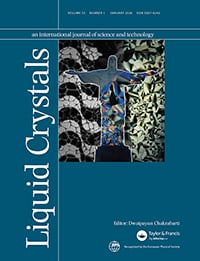
Selected articles from the conference will be published in the international journal Liquid Crystals from Taylor & Francis, as a special issue titled “Discotic Liquid Crystals: 50 Years of Molecular Order and Innovation”.
Visit the JournalThe detailed scientific programme, including plenary, keynote and invited lectures, will be published here once the speaker list is finalised.
Swipe the table sideways to see all columns.
| Day | Time | Session | Details |
|---|---|---|---|
|
Day 1 16 September 2027 |
9:00 AM – 5:00 PM | Plenary, keynote, invited and contributory lectures; poster session | To be updated |
|
Day 2 17 September 2027 |
9:00 AM – 5:00 PM | Plenary, keynote, invited and contributory lectures; poster session | To be updated |
|
Day 3 18 September 2027 |
9:00 AM – 5:00 PM | Plenary, keynote, invited and contributory lectures; poster session | To be updated |
|
Day 4 19 September 2027 |
9:00 AM – 5:00 PM | Plenary, keynote, invited and contributory lectures; poster session | To be updated |
All registered participants will receive a certificate of participation, signed by the Main Coordinator along with the Dean of Outreach Education & Skilling and the CET Coordinator, IIT Guwahati.
Practical information for delegates travelling to IIT Guwahati. Detailed guidance will be sent to all registered participants ahead of the conference.
By Air
Lokpriya Gopinath Bordoloi International Airport (GAU), Guwahati, is about 20 km from the IIT Guwahati campus — roughly a 40-minute drive — and is well connected to Delhi, Kolkata, Mumbai, Bengaluru and Chennai, with international connections via Delhi and Kolkata. A pre-paid taxi counter is available in the arrival lounge, and app-based cabs serve the campus.
By Rail
Guwahati Railway Station (GHY) and Kamakhya Railway Station (KYQ) are the principal railheads, connected to all major Indian cities.
By Road
Taxis and app-based cabs are readily available from the airport and railway stations to the campus at Amingaon, North Guwahati.
On-campus accommodation is included in the registration fee for all categories except Research Scholars (without accommodation).
Delegates will be accommodated in the institute guest house and hostels, allocated according to category and availability. Accommodation is confirmed on a first-come, first-served basis, so early registration is strongly encouraged.
Accompanying persons and delegates preferring hotel accommodation in Guwahati city may make their own arrangements; a list of recommended hotels will be shared closer to the conference.
Check-in and check-out details will be circulated with the confirmation e-mail.
International delegates require a valid Indian visa. Participants should apply for a Conference Visa and must not travel on a tourist visa, as attendance at a conference is not permitted on that category.
Applications are made through the Indian Mission in your country or the Indian Government's official visa portal. Please apply well in advance, as conference visas require clearance and can take several weeks to process.
Registered delegates who need a formal invitation letter for their visa application may request one from the conference secretariat after registration is confirmed.
Delegates planning to extend their stay will find a great deal to explore in and around Guwahati, the gateway to North-East India.
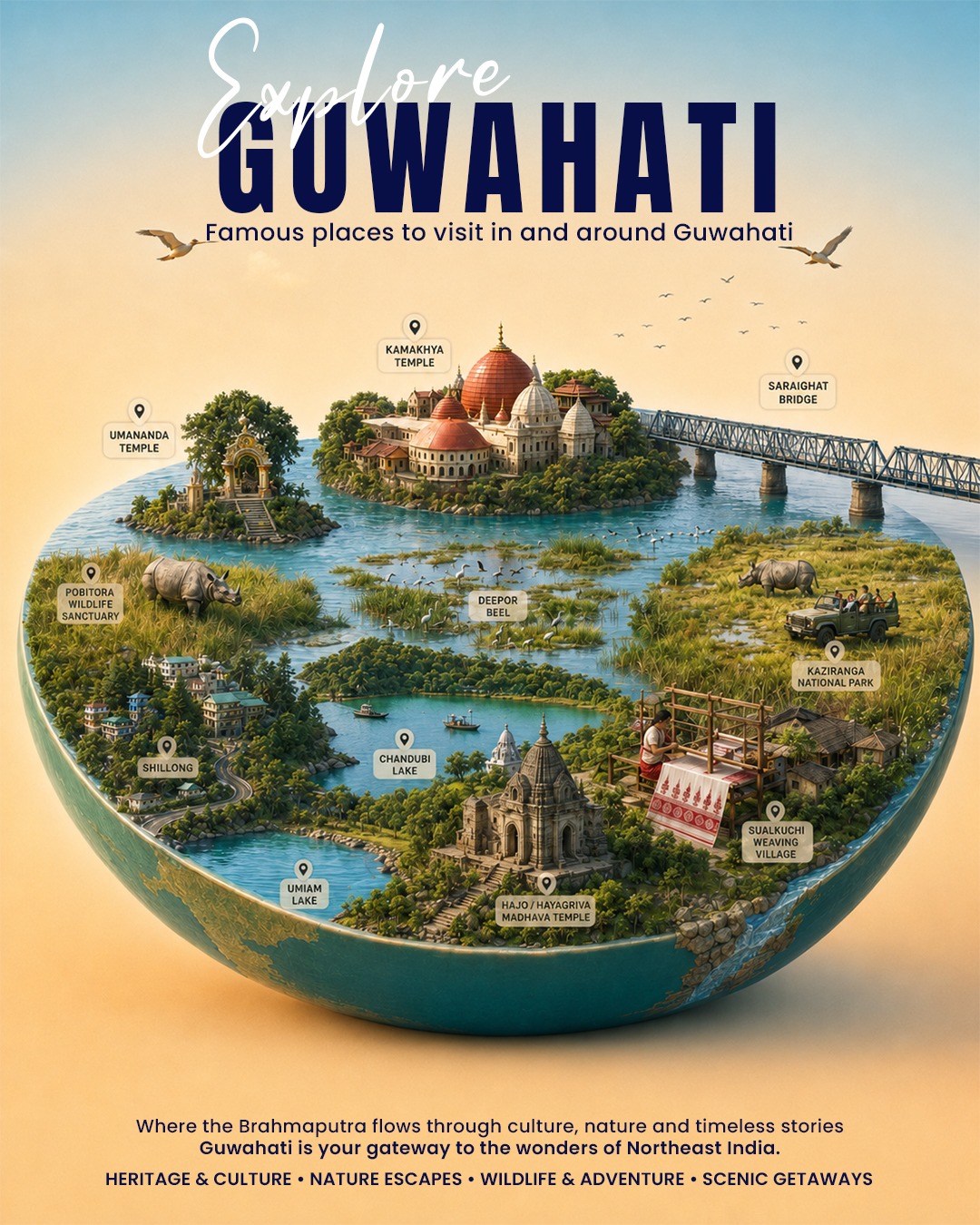
Kamakhya Temple
One of the most revered Shakti temples in India, set on Nilachal Hill overlooking the city.
Umananda Island
The world's smallest inhabited river island, reached by ferry across the Brahmaputra.
Kaziranga National Park
UNESCO World Heritage site and home of the one-horned rhinoceros, around 200 km from Guwahati.
Pobitora Wildlife Sanctuary
A compact rhino sanctuary roughly 50 km away, popular as a day trip.
Brahmaputra River Cruise
Sunset cruises on the Brahmaputra depart from Guwahati city.
Assam State Museum
Regional history, sculpture and the material culture of the North-East.
Indicative suggestions only. Distances and travel times vary; delegates should plan excursions independently of the conference programme.
North Guwahati, Amingaon, Guwahati – 781039, Assam, India
Lokpriya Gopinath Bordoloi International Airport (GAU) — approximately 20 km from campus.
Guwahati Railway Station — approximately 20 km from campus.
On-campus guest house and hostel accommodation for registered participants.
A scenic 700-acre campus on the north bank of the Brahmaputra river.
Convener
Department of Chemistry, IIT Guwahati, Guwahati – 781039, Assam, India
Convener
Department of Chemistry, IIT Guwahati, Guwahati – 781039, Assam, India